Fuzzycards TCG Review: 150 Cards, Five Forces, and the 589 Prophecy
The XRP Ledger just got a real trading card game — five Forces, 60 holos, a win condition that requires exactly 589 damage, and the ledger's own architect wearing the mascot. Full breakdown, plus an honest read for card shop owners.
Ethereum got monkeys. Solana got a rotating cast of exit liquidity. The XRP Ledger just got a 150-card trading card game with a prophecy hard-coded into the win condition — and the man who architected the ledger is wearing one of its bears as his profile picture.
Disclosure, because we do receipts here: Terminalcraft holds a Fuzzybear. We bought it before writing a word of this — not as an investment thesis, but because we spent months watching this party through the window, and standing outside watching a party is a lot less fun than being at it. So yes, we’re biased. The difference between us and the outlets we mock is that we just told you. Judge the receipts, not the writer.
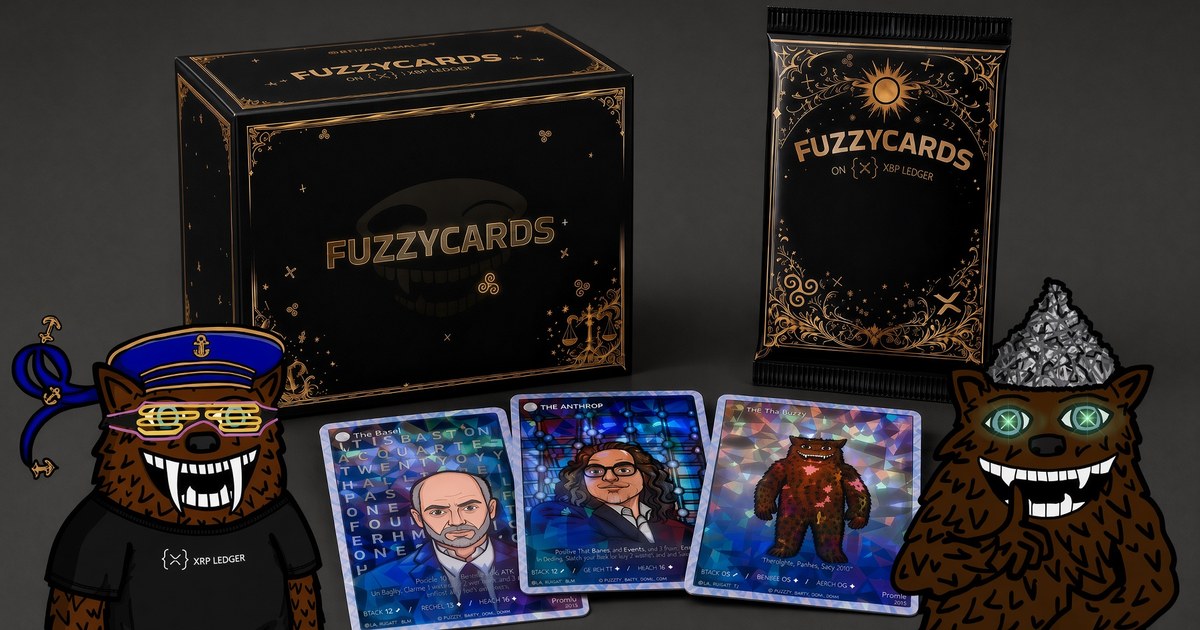
Let’s be clear about what happened here, because the mainstream crypto press will miss it entirely — they always do, right up until they’re writing the retrospective.
Fuzzycards is not a PFP project with a game bolted on for a roadmap slide. It is not a “gamified ecosystem” — the phrase every dead project used in 2022 right before the Discord went quiet. It is an actual trading card game, with an actual rulebook, actual combat math, and a deckbuilding format tight enough that you could hand it to a Magic player and watch them go silent for twenty minutes.
This piece is a full breakdown of the game — the rules, the math, the rarity structure — and then a section written specifically for card shop owners weighing up whether this belongs on their shelf. Jump to “The Shop Owner’s Read” if that’s why you’re here.
The Lore Was Never Decoration
We wrote in July that Fuzzybears is the true crown collection of the XRP Ledger — born from a wallet activated in the Opencoin era, immortalized by that January 1, 2014 DEX order of 1 XRP for 1 BTC, and validated by the record 41,893 XRP sale of Fuzzybear #0.
Most projects would have laminated that story onto a t-shirt and called it heritage.
Fuzzycards turned it into mechanics.
Every card in the set is rooted in the lore of BG123, the prophecies, the riddles, and the movement behind $FUZZY — the number one meme on XRPL. Not as flavor text at the bottom of the card. As the rules themselves. The deck you draw from is called The Scroll. Your back row is The Vault. Your front row is The Altar. The phase where you attack is called Validate, and the phase where you gain energy is called Genesis.
You do not accidentally name a combat phase after ledger consensus. That is someone who understood the assignment.
The Schwartz Chapter: When the Architect Puts the Bear On
Here is the part that changes the risk profile of this entire category, and it has nothing to do with the rulebook.
David Schwartz — @JoelKatz, original architect of the XRP Ledger, Ripple’s CTO Emeritus, one of the three people who can genuinely claim to have built this thing — spent 2026 attaching himself to Fuzzy in public, on-chain, and repeatedly.
He speaks in layers. He always has. Technical precision wrapped in careful disclaimers, delivered with enough deniability to survive a subpoena and enough signal to keep the Riddlers up all night. If you have followed him for any length of time you know the pattern: the words hedge, the actions don’t.
Watch the sequence.
1. The trustline
He posted it himself, with the on-ledger TrustSet transaction attached:
“As I promised, I have added a trust line for $FUZZY. This is not an endorsement of the project in any way. I know much less about this project than you probably think. But I do think it’s a fun community.”
Read that like a lawyer, because it was written like one. “Not an endorsement.” “I know much less than you think.” Textbook JoelKatz containment.
Now read what he actually did. He said he had promised to do it. He then executed a real transaction on a public ledger, with a trust limit in the hundreds of billions, and broadcast the hash. And he closed on “fun community” — which is the only unhedged clause in the entire post.
The disclaimer is the part you’d write if you were being careful. The transaction is the part you’d only write if you meant it. The coverage understood which half mattered. So did the community.
2. The NFT and the liquidity
He accepted a community-gifted Fuzzybear — including the “David hair” variant, which fans clocked instantly. Then, per reporting at the time, he went further and deposited XRP and FUZZY into the XRP/FUZZY AMM pool, framing it as the least he could do after being gifted tokens, and noting it could let him earn on volatility and swaps.
That is not a like. That is not a retweet. That is capital, in a pool, on the ledger he designed, in a memecoin’s AMM. You can look it up. That is the entire point of building on a public ledger — and he knows it better than anyone alive.
3. The profile picture
Then the loudest signal in the sequence, and the one that made the aggregators lose their minds: during a live X Space packed wall-to-wall with Fuzzy avatars, Schwartz swapped his high-follower @JoelKatz profile picture to a blue Fuzzybear — sunglasses, fangs, the signature David hair.
The reaction was instant and split exactly along the lines you’d expect. The XRPL community treated it as a coronation. The outside press treated it as a scandal: BeInCrypto, TipRanks and U.Today all ran variations of the same panic. Note the framing in that last one: “fuels XRP conspiracy theory.” Nobody writes that headline about a project that doesn’t matter.
By community accounts from the Space itself, he went further on the mic — “you guys are awesome,” and in at least one retelling, an explicit “and this is an endorsement.”
Precision note, because we do receipts here: the trustline quote above is verbatim from his own post and independently reported. The spoken line is community-recounted from a live Space and we have not sourced a primary recording. We are flagging the difference rather than laundering it. The written record hedges. The on-chain record and the avatar do not need to.
Why the Riddlers read it correctly
The decoders — the ones who spent years on Bearableguy123, Mr. Pool, the Ripple Riddler, the whole cryptic-image tradition — were never confused about this. They were never reading the disclaimer. They were reading the sequence: promise, transaction, NFT, liquidity, avatar, live appearance. Each step costs more than the last. Each one is harder to walk back.
Critics pointed at his older comments about meme-coin investing being distasteful and called it a contradiction. It isn’t one, and the distinction is not subtle. He never said the coin was a good buy. He said the community is fun, and then he used the ledger’s native primitives — trustlines, XLS-20 NFTs, AMMs — the way they were designed to be used, in public, at the highest technical level in the ecosystem.
That is a man demonstrating his own product. It just happens that the demo is wearing fangs.
Why this matters for the cards, and for anyone thinking about stocking them: Fuzzycards is not built on a rented audience. It is built on the one XRPL IP that the ledger’s original architect has publicly, financially, and visually associated himself with. In a category where 95% of projects are one founder-exit away from worthless, that is about as close to a durability signal as crypto collectibles get.
The 589: The Most Audacious Win Condition in Any TCG
Back to the game, because the game earns it.
Fuzzycards has three ways to win. Two are conventional:
- Liquidation — drop your opponent’s Life to 0. Standard. Boring. Effective.
- Scroll Out — your opponent can’t draw when required. The prophecy has run out. Mill, by another name.
And then there is the third one.
THE 589 — deal exactly 589 total damage in a single game. Instant win. Regardless of either player’s Life total. Going over 589 does not trigger it. It must be exact.
Read that again.
You track cumulative damage across the entire game — damage to cards, damage to Life, Pierce overflow, all of it. And if you can steer that running total to land on 589 on the nose, you announce “The Prophecy is Fulfilled” and you take the game off the table. Your opponent could be sitting at 30 Life with a full Altar. Doesn’t matter. The number hit. The game is over.
Every crypto community has a number it whispers. 589 is ours. Somebody built a card game where that number is a literal win condition — and made it punishing, because one point of overkill on the wrong attack and the whole line evaporates. Overshoot and you’re back to grinding out Liquidation like a peasant.
That is not a gimmick. That is a third strategic axis running underneath every single attack you declare for the entire match. You are simultaneously playing a board game, a resource game, and an arithmetic tightrope. Show me another TCG doing that. I’ll wait.
And from a retail perspective — hold that thought. A win condition that requires players to track a running number out loud across a whole match is a spectator mechanic. It creates tables people gather around. We’ll come back to why that matters on a shop floor.
The Five Forces: Where It Gets Properly Ideological
All 150 cards are aligned to one of five Forces, split perfectly — 30 cards each. No filler faction. No “we ran out of ideas for the fifth one.”
| Force | Theme | Cards |
|---|---|---|
| Power | Strength, dominance, the flippening | 30 |
| Clarity | Truth, justice, the verdict | 30 |
| Prophecy | Mystery, riddles, the inevitable | 30 |
| Conviction | Diamond hands, holding, faith | 30 |
| Wisdom | Knowledge, patience, strategy | 30 |
Those aren’t fantasy elements with a crypto coat of paint. That is the psychological profile of every XRP holder who survived the last decade, sorted into a combat triangle.
And the cycle is the best-written thing in the rulebook:
- Wisdom outlasts Power. The ones who waited beat the ones who screamed.
- Power crushes Clarity. Raw force doesn’t care what’s true. Ask anyone who’s read a court filing lately.
- Clarity disproves Prophecy. Receipts beat narratives. Every time.
- Prophecy shakes Conviction. The riddle gets in your head and your hands stop being diamond.
- Conviction ignores Wisdom. Sometimes you just hold, and the smart money’s spreadsheet doesn’t survive contact with someone who simply refuses to sell.
Attack into a Force you beat and you get +3 ATK. That’s it. Clean, brutal, and it means deckbuilding is a political statement about how you think the world actually works.
The Combat Math Is Tighter Than It Looks
The damage formula is short enough to fit on a shirt:
DAMAGE = ATK − (DEF ÷ 2) + FORCE BONUS
Defense is halved and rounded down before subtraction, and here’s the design decision that makes the whole thing sing: every attack deals at least 1 damage. No dead hits.
You cannot wall out an aggressive board and coast. Chip damage always lands — which means the 589 counter is always ticking, and every “safe” turn is quietly moving you toward or past your own prophecy.
The rest of the combat layer is genuinely well-built:
- Pierce — overkill damage on a KO’d card overflows straight into the opponent’s Life. Nothing is wasted.
- Direct Attack — empty Altar means you eat full ATK with no DEF reduction. Leave the door open, take the whole hit.
- Guard must be attacked first. Stealth cannot be targeted until it attacks. Bridge lets a card duck into The Vault to dodge an incoming attack — a keyword named after the exact thing XRP is supposed to be, which is the kind of detail you only get from someone who actually lives here.
Add Rush, Drain, Burn X, Shield, and Silence, layer in seven ability triggers — On Deploy, On Attack, On Hit, On KO, On Kill, Passive, Activate — and you have a system with real interaction depth. This is not a coin-flip game with pretty art.
The Board: The Altar and The Vault
Three front slots. Three back slots. That’s the whole field, and the constraint is the point.
The Altar is where combat happens — your cards there can attack, and can be attacked. The Vault is the protected back row: cards there can’t attack and can’t be targeted, unless the enemy Altar is empty and the wolves get in.
And the Settle phase lets you move cards freely between the two, every single turn, for free. Vault → Altar and it can attack this turn. Altar → Vault and it’s safe but silent.
That one free action is the entire skill curve of the game. When do you expose your best piece? When do you pull it back into custody? Every XRP holder has played this exact game with their own bags for ten years. Now it has a rulebook.
You start at 33 Life and 0 Energy, gaining +1 per turn to a max of 5 — and critically, energy accumulates and carries over. It does not reset. Bank it, or spend it. Patience is a resource and the rules say so out loud.
The Collector Layer: 60 Holos and a Hard Legendary Cap
Now the part that decides whether this thing has legs in five years.
150 cards. 60 of them are holographic — every Legendary, every Epic, every Rare. And the rarity ladder is properly steep:
| Rarity | Count | ATK | DEF | HP | Cost | Holo |
|---|---|---|---|---|---|---|
| Legendary | 10 | 11–13 | 9–13 | 17–18 | 5 | Yes |
| Epic | 20 | 8–10 | 7–9 | 12–13 | 4 | Yes |
| Rare | 30 | 7–10 | 5–8 | 9–11 | 3 | Yes |
| Uncommon | 40 | 5–8 | 4–7 | 6–8 | 2 | No |
| Common | 50 | 3–6 | 3–6 | 4–6 | 1 | No |
Ten Legendaries. In the entire set. And the deckbuilding rules cap you at one copy per deck — max 3 of anything else, exactly 30 cards, minimum 15 Heroes, and no Force restrictions at all so you can build whatever heresy you want.
Do the math on what that does to demand. A competitive player doesn’t want a Legendary as a flex. They need it as a slot. That is the mechanic that turned early Magic rares into an asset class, and it is sitting right there in the Fuzzycards rulebook, quietly.
The card names alone tell you the culture is intact: General Fuzzy. The Vault Door — Permissioned Access. The Purple Brick Road. The Golden Ticket. The Riddler’s Den. Patience Pays. The Fog Lifts. Phase II Awakening. The 589 Countdown. Fuzzy The Kingpin. Stack Sats? Stack XRP.
Every one of those is an inside joke to about forty thousand people and completely opaque to everyone else. That is exactly how cultural moats get built. Punks did it. Nobody outside early Ethereum understood why a pixelated alien was worth a house, either.
The Shop Owner’s Read: Does This Belong on Your Shelf?
Right. If you run a card shop, you’ve been pitched roughly nine hundred “crypto TCGs” since 2021 and every one of them was vapor. You are correct to be cynical. So here is the honest evaluation, structured the way you’d actually assess a new line.
What the product actually is
A complete, self-contained 150-card set with a written rulebook, five balanced factions, a real combat system, eight keywords, seven trigger windows, and three win conditions. It is a playable game, not a numbered art series with a rulebook stapled on. That distinction is the entire difference between a line that reorders and a line that sits in your case until you discount it.
The set is finite and defined — 110 Heroes, 20 Relics, 20 Events. 60 holos concentrated in the top three tiers. Ten Legendaries. Nobody has to explain a 4,000-card back catalogue to a new customer.
The demand signals, in order of weight
- The architect of the underlying blockchain wears the IP as his avatar. Covered above. In collectibles, provenance and endorsement are the two things that survive a downturn, and this line has the closest thing crypto has to both.
- A verified record sale in the parent collection. Fuzzybear #0 went for 41,893 XRP — the largest single NFT sale in XRP Ledger history at the time. That’s not floor-sweeping. That’s a buyer with conviction and a public record.
- An existing, organized, terminally-online community. The $FUZZY / Fuzzybears crowd already exists, already spends, already gathers in Spaces nightly. You are not creating demand from zero. You are giving an existing tribe a physical object.
- Crossover buyers your competitors don’t have. This reaches crypto holders who have never set foot in a game store. That is a genuinely new customer walking through your door with a wallet, not a reshuffle of your existing regulars’ budget.
- A mechanic built for spectacle. The 589 is a table-gathering event. When a player is at 574 cumulative damage and has to find exactly 15, the whole shop leans in. Mechanics that create crowds create sales.
Where the chase value concentrates
If you’re planning case breaks, singles pricing, or a display case, the structure tells you where value pools:
- The 10 Legendaries are the entire top of the market. One-per-deck cap means competitive demand is structural, not sentimental — every serious player needs one, and only one, which is the cleanest possible demand curve for a singles business.
- Lore-anchor cards will outrun their rarity tier. The 589 Countdown, General Fuzzy, Fuzzy The Kingpin, The Vault Door — these carry cultural weight beyond their stat line. Price them by narrative, not by rarity symbol.
- The 60 holos are your case-break driver. Every Rare and above is foiled, which means the pull moment is frequent enough to keep breakers breaking.
How to run it on the floor
Three plays, in order of effort:
- Learn-to-play nights. The rulebook is short and the core loop teaches in about ten minutes. Six phases, one formula, three win conditions. That is a demo you can run at the counter between customers.
- Force-locked events. Five factions with a hard counter-cycle is a ready-made event format. Run a night where each player registers a Force allegiance. It’s tribal, it’s social, and it sells singles from whichever Force is underrepresented.
- The 589 bounty. Post a standing prize for the first player in your shop to win by The Prophecy. It will take weeks. That is the point — it’s a persistent reason to come back.
What we cannot tell you yet, and won’t pretend to
We do not have confirmed retail pricing, pack configuration, case counts, distributor terms, or allocation policy, and we are not going to invent them so this section reads more complete. Before you commit shelf space or capital, get these in writing:
- MSRP per pack and per box, and whether there is an enforced MAP policy
- Cards per pack, packs per box, boxes per case, and the published pull rates for Rare / Epic / Legendary
- Whether the set is print-limited or open-print — this is the single most important question for a collectible line and the one most likely to be answered vaguely
- Reprint policy for the 10 Legendaries. If they can reprint the chase cards freely, your singles case is exposed
- Direct-to-consumer versus retail channel conflict — does the publisher undercut you on their own store?
- Return, damage and allocation terms; whether there is any organized-play or store-kit support
Stocking enquiries go through fuzzycards.com. Ask the print-run question first and judge the whole relationship on how straight the answer is.
And shop owners — talk to us. Terminalcraft sits inside this community every day. When pricing, pull rates and print-run policy get published, we’ll cover them with the same honesty as everything above — subscribe to the Terminal Brief and you’ll have it the morning it drops. Running a shop and weighing this line up? Email hello@terminalcraft.io — tell us what the distributor told you, and we’ll tell you if it matches what we’re seeing on-chain. No charge. We’d rather the shops that stock this line win.
The honest risk, stated plainly
The crypto-native audience is real but it is also concentrated and correlated. If XRP has a bad year, this shelf gets quieter than your Magic shelf does. Budget an initial order you’d be comfortable holding through a drawdown, watch sell-through on your first case before you scale, and treat the first six months as a demand test rather than a commitment. That is not pessimism — it’s how you’d treat any new line from any publisher without a ten-year track record.
The Honest Catch
We don’t do pure hopium here, so: a TCG lives or dies on the metagame, and no rulebook survives contact with players. The 589 win condition is beautiful on paper and we will not know until people are grinding real matches whether it’s a live strategic axis or a trophy that gets hit twice a year. Legendaries at 17–18 HP and 5 cost need the energy curve to hold up under pressure. And a card game needs opponents — the design is only as good as the player base that shows up to abuse it.
None of that is a knock. It’s the same catch that applied to every great TCG in its first year. It just means the next twelve months are the ones that matter.
The Bigger Game — Our Tin-Foil, Worn Proudly
Everything above this line is receipts. This section is not, and we’re telling you that up front, because that’s the difference between tin-foil and laundering.
Here is what we think, as holders, from inside the room: Fuzzy is not behaving like a card game launch. Card game launches buy ads. This thing accretes people. The architect of the ledger doesn’t just acknowledge it — he sequences into it, step by step, each move costing more than the last. The record holder of the parent collection didn’t flip — he held, publicly, with his name on the receipt. Marketplace founders follow. Builders follow. The Spaces fill up night after night with people who talk less like bag-holders and more like people keeping a story alive.
We don’t know what this becomes. We’re not going to invent a roadmap and pretend we saw a deck. But we’ve watched enough of these cycles to know the difference between a product looking for a community and a community that keeps producing artifacts — and Fuzzy is the second kind. The bears came first. Then the token. Now a card game where the prophecy is a win condition. Each artifact is another chapter, and the chapters are being written in public, by the holders, in real time.
That’s the actual thesis for the cards. Not “they might go up.” A trading card from this set is a physical page of a decentralized story — one that the man who built the ledger has chosen, very deliberately, to appear in. When a movement writes its own mythology and then prints it on foil, owning a piece is how you sign the guestbook.
We bought a bear because watching this party through the window stopped making sense. We’re in the lore now. So are you, if you’re reading this. That’s how it works.
What They’re Not Telling You
While the rest of the market spent 2026 recycling the same three NFT narratives and waiting for a marketplace to prop their floor back up, the Fuzzy camp shipped a complete game system with 150 pieces of art, five balanced factions, eight keywords, seven trigger windows, and a win condition that requires you to do arithmetic under pressure — and got the original architect of the XRP Ledger to put the mascot on his own face.
The collections that endure are never the ones with the loudest marketing. They’re the ones that capture a moment so cleanly that people want to own a fragment of it — and then keep building on it while everyone else is posting floor-price screenshots.
Fuzzybears earned the crown on history. Fuzzycards is what you do once you’re wearing it.
Outsmart your opponent. Manage your resources. And prove you saw it coming before anyone else.
589.
Yes, of course there’s a shirt.
The official Fuzzycards rulebook is available at fuzzycards.com/game-rules.
Fuzzycards FAQ
How many cards are in Fuzzycards TCG?
150 cards total in the Genesis set — 110 Heroes, 20 Relics, and 20 Events, split evenly across five Forces at 30 cards each. 60 of the 150 are holographic.
What is the 589 win condition?
The 589 is a third, prophecy-based path to victory. If your cumulative damage across a single game — damage to cards, damage to Life, and Pierce overflow combined — reaches exactly 589, you win instantly regardless of Life totals. It must be exact; going over does not trigger it.
How does combat work in Fuzzycards?
Damage = ATK − (DEF ÷ 2) + Force bonus, with defense rounded down. Every attack deals at least 1 damage. Attacking into a Force you counter grants +3 ATK. Excess damage on a knockout overflows into the opponent’s Life as Pierce.
What are the deckbuilding rules?
Exactly 30 cards per deck, a minimum of 15 Heroes, a maximum of 3 copies of any card, and a maximum of 1 Legendary per deck. There are no Force restrictions — you can mix all five freely.
How do you start a game of Fuzzycards?
Both players shuffle a 30-card deck (The Scroll) and reveal the top card in the Genesis Flip — higher Cost wins and chooses turn order. The first player draws 5 cards, the second draws 6 to offset going second. Each player starts at 33 Life and 0 Energy, with one mulligan available per game.
Did David Schwartz endorse Fuzzy?
He added an on-chain trustline for $FUZZY and published the transaction, while explicitly writing that it was “not an endorsement of the project in any way” and calling it “a fun community.” He subsequently accepted a gifted Fuzzybear NFT, was reported to have added XRP/FUZZY AMM liquidity, and changed his @JoelKatz profile picture to a Fuzzybear. The written disclaimer and the on-chain actions point in different directions — readers can draw their own conclusion.
Which Fuzzycards are the chase cards?
The 10 Legendaries are the top of the market — they are holographic, cost 5 Energy, carry the highest stat lines in the set, and are capped at one per deck, which makes competitive demand structural. Lore-anchor cards such as The 589 Countdown, General Fuzzy and Fuzzy The Kingpin carry cultural value above their rarity tier.
Can card shops stock Fuzzycards?
Retail and stocking enquiries run through fuzzycards.com. Before committing, shop owners should confirm MSRP and MAP policy, pack and box configuration, published pull rates, whether the print run is limited or open, the reprint policy on Legendaries, and whether the publisher sells direct in competition with retail.